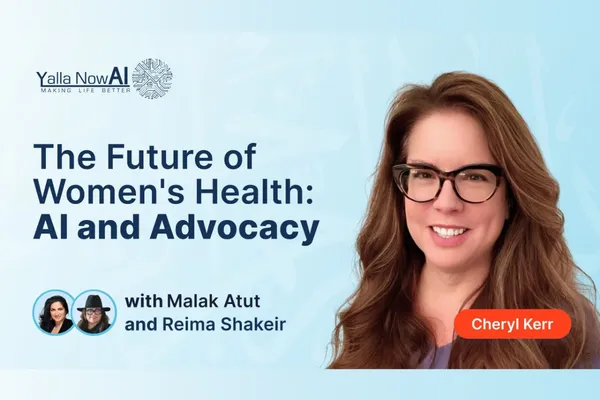
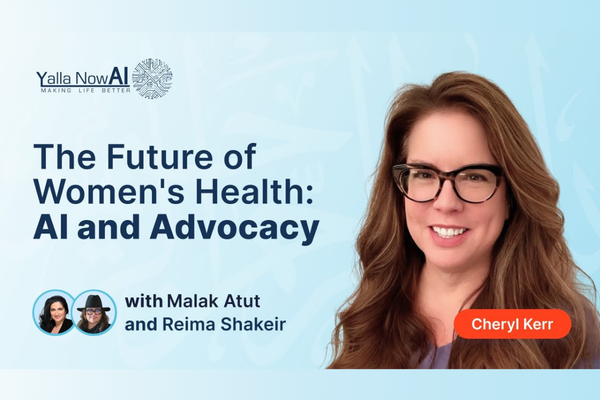
The Future of Women’s Health: AI and Advocacy
YALLA NOW AI Podcast • Episode 26
Listening to Women’s Health Through AI: A Conversation with Cheryl Kerr
A Year in the AI Trenches
Some podcast conversations stay with you because they give language to something you’ve felt but never fully articulated. Our latest Yalla Now AI episode with Cheryl Kerr, a women’s health advocate and industry veteran, did exactly that.
Cheryl has spent decades navigating the realities of women’s health: painful menstrual cycles from adolescence, fertility struggles, and the eventual arrival at menopause with a sense of relief and clarity that many women don’t feel permitted to express. Her lived experience is not just personal—it’s systemic. And one line from our conversation captured the heart of it:
“Without information, there is no advocacy.”
That statement is more than a soundbite. It’s a diagnosis of the gap that has defined women’s health for generations. Too many women are navigating symptoms, fertility challenges, perimenopause, and menopause without the vocabulary, data, or support to ask better questions. Without language, there is silence. Without information, there is no power.
Reading time: 6 minutes • Category: Technology & Innovation
Listen On Other Platforms:
Apple Podcasts | iHeart | YouTube | Spotify
Why Women’s Health Has Been Sidelined
For decades, women’s health has been under‑researched, underfunded, and often dismissed. From menstrual pain minimized as “normal” to fertility struggles treated as private burdens, the system has left women without answers. Cheryl’s story reflects what millions experience: being told to endure rather than being offered solutions.
But change is happening. Advocacy, research, and technology are beginning to converge. And AI is entering the conversation in ways that could reshape the landscape.
Where AI Can Help
In our discussion, we explored practical ways AI can support women’s health:
Appointment Preparation: AI can help patients organize symptoms, questions, and history so that their limited time with a doctor—often just 8 minutes—counts.
Telehealth as a Bridge: For caregivers, rural residents, or those with mobility challenges, AI‑enabled telehealth can expand access to care.
Diagnostics with Caution: AI promises breakthroughs in diagnostics, but Cheryl emphasized the data problem. If women’s health remains under‑researched, then “garbage in, garbage out” becomes a real risk.
Community Support: Online platforms powered by AI can connect women to resources, peer groups, and advocacy networks, turning isolation into solidarity.
Everyday AI: Not Just for Tech Bros
One of the most striking parts of the conversation was Cheryl’s candid description of how she uses AI in her daily life. From drafting posts to updating a resume after nearly 30 years in one company, even figuring out dinner based on what’s in the fridge—AI became a practical companion.
This detail matters. It reframes AI not as a tool for Silicon Valley insiders but as something for people with full lives, responsibilities, and limited time. AI for caregivers, professionals, and women managing complex realities—not just “tech bros.”
The Bigger Picture: Advocacy Meets Innovation
The episode underscored a critical truth: innovation must fund the foundations. Without robust data, women’s health risks being left behind in the AI revolution. Without advocacy, technology risks being designed without the voices of those it’s meant to serve.
Cheryl’s perspective is a reminder that care is relational. It runs on trust, judgment, and presence. If AI enters this space, it must be designed to protect those qualities, not erode them.
Why This Matters Now
In 2026, AI literacy is becoming a baseline competency. But literacy isn’t just technical—it’s relational. Understanding how systems think, where they fail, and how to direct them responsibly is essential. Women’s health is the test case for whether technology will serve humanity or simply optimize it.
If you’ve ever left a doctor’s appointment wishing you’d asked one more question—or realized later you minimized a symptom that mattered—this episode is for you. And if you work in healthcare, product design, or data, Cheryl’s point is a gut‑check: without information, there is no advocacy.
Closing Reflection
This conversation is not anti‑technology. It’s developmental. It’s about recognizing that ease and productivity shape how humans grow, relate, and create. And in women’s health, the stakes are too high to ignore.
The future of care tech should be shaped by those who’ve lived it. Women, caregivers, and advocates hold the domain expertise that AI systems desperately need. The question is whether we will design technology to lighten the load—or to extract more from already exhausted people.
That’s why this episode matters. It’s not just about AI. It’s about agency, advocacy, and the kind of healthcare revolution women have been waiting for.
🧡 Follow us on our socials:
Instagram:@yallanowai
LinkedIn:Yalla Now AI
TikTok: @yallanowai
YouTube:@YallaNowAI
Spotify:Yalla Now AI

Comments
Be the first to comment.