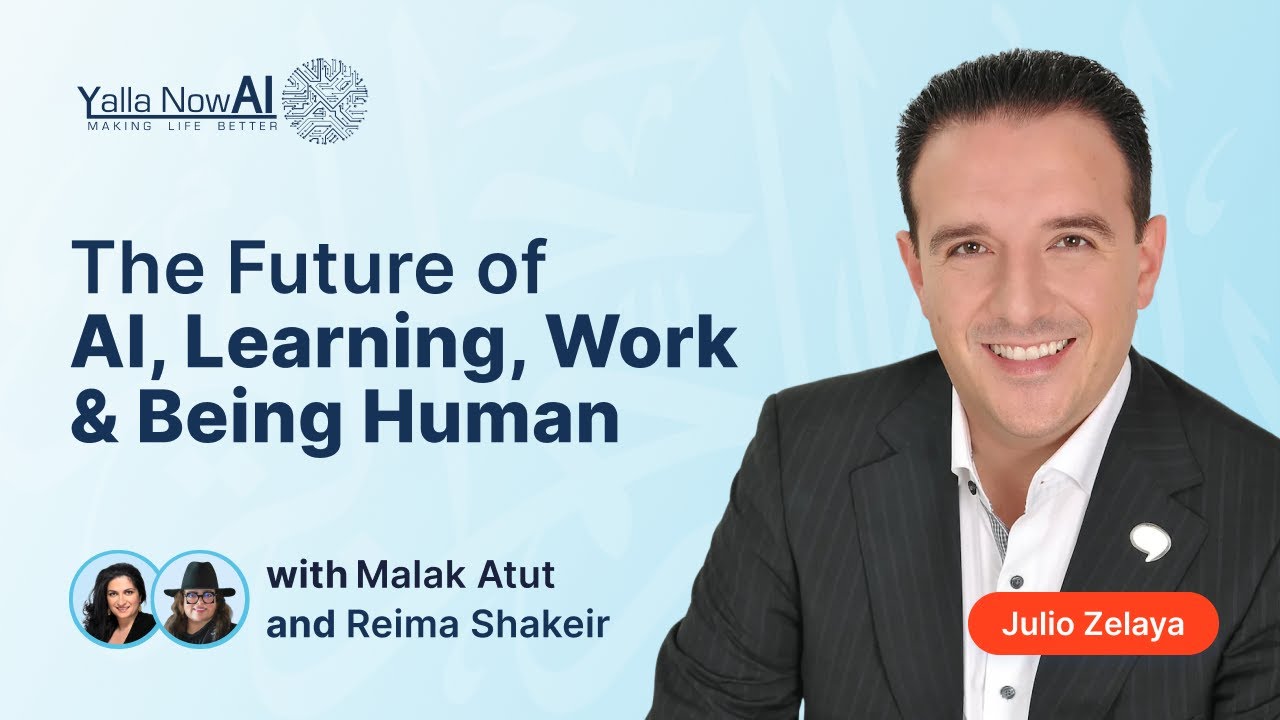
Can AI Help Us Become More Human?
YALLA NOW AI Podcast • Episode 11
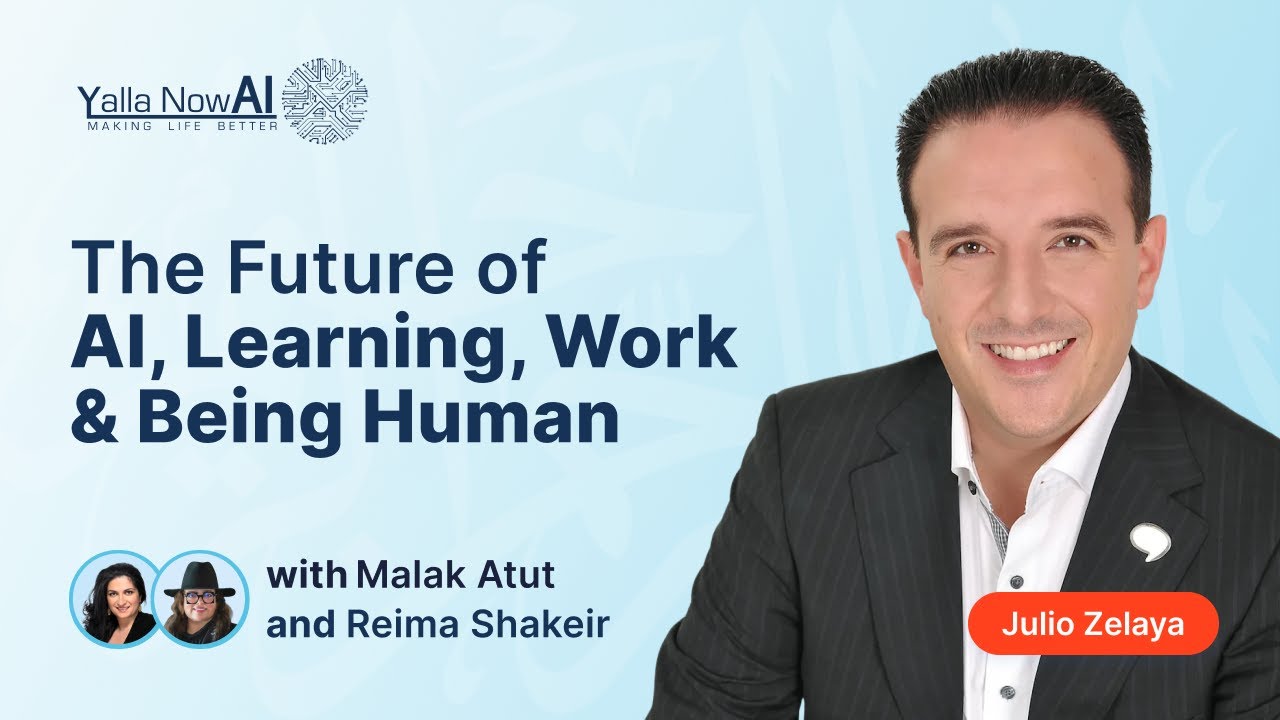
The Future of AI, Learning, Work & Being Human
AI isn’t just for Silicon Valley engineers—it’s for everyone. Whether you’re balancing work, family, or endless to-do lists, AI can simplify life. But here’s the deeper question: Can AI actually help us become more human?
This episode of Yala Now AI explores that idea with Julio Sallaya, an educator, entrepreneur, and AI expert who bridges technology and humanity. His insights challenge us to rethink not just how we use AI, but why.
Reading time: ~9 minutes • Category: Technology & Humanity | Future of Workforce
Listen On Other Platforms:
Apple Podcasts | iHeart | YouTube | Spotify
Julio’s Origin Story: Roots in Entrepreneurship and Academia
Julio grew up in Guatemala, one of the most entrepreneurial countries in the world. His father was a business builder, while his mother founded universities and authored books. From an early age, Julio was immersed in both entrepreneurship and academia—two worlds that shaped his vision.
He combined these passions with technology, founding Guatemala’s first fully online accredited school. His mission: democratize education so that rural and underserved communities could access quality learning.
Listen to the full conversation
Hit play on Spotify below, then scroll to dive into the frameworks, timestamps, and visuals we reference throughout the episode.
Education and AI: More Than Cheating
When people talk about AI in schools, the conversation often centers on cheating. Students use AI to generate essays, and institutions scramble to police it. But Julio argues that’s the wrong question.
“A lot of students are not seeing value in the assessments. They’re outsourcing because they don’t feel engaged.”
The real issue isn’t AI—it’s misaligned education systems. When learners love what they do, they use AI to enhance creativity, not replace it.
Work, Burnout, and Alignment
Julio draws parallels between disengaged students and disengaged workers. According to Gallup, nearly 70% of people worldwide are not engaged in their jobs. That disengagement fuels burnout and the desire to outsource tasks to machines.
But when work aligns with passion, AI becomes a tool for amplification. Instead of replacing human effort, it helps us do more of what lights us up.
AI and Human-Centered Innovation
Julio emphasizes that AI should not substitute humanity—it should empower it. Compassion, empathy, and creativity are irreplaceable. Yet many people are using AI for therapy, companionship, or coaching, which exposes a deeper societal gap: we’re not cultivating enough human connection.
“Large language models don’t really understand emotions. They predict patterns. What we need is to regain the fundamental things that make us human.”
Rethinking Business Schools and Institutions
Business schools train future leaders, but Julio points out systemic flaws. Accreditation rules often prevent innovators like Mark Zuckerberg from teaching, despite their real-world expertise.
Technology, however, is democratizing influence. Passionate creators on YouTube or social platforms often inspire more than traditional professors. The future of education may lie in mentorship, deep conversations, and human-centered learning, not rigid institutional structures.
Language, Culture, and AI Barriers
Most large language models are trained on English, creating barriers for non-English speakers. Julio highlights the importance of data diversity in AI training. Without inclusive datasets, AI risks reinforcing cultural and linguistic divides rather than bridging them.
The Big Shift: AI as Our “Last Invention”
Julio warns that AI is unlike past innovations such as the printing press. For the first time, we’re building a technology with agency—one that can act, respond, and even question us.
Some researchers call AI humanity’s “last invention” because it will invent everything else. That makes this moment critical: we must decide how to use AI to enhance happiness, compassion, and creativity, not just efficiency and profit.
Key Takeaways
AI can democratize education and empower creativity.
The real challenge isn’t cheating—it’s disengagement in work and learning.
Human-centered innovation means using AI to amplify empathy, not replace it.
Institutions must evolve to embrace mentorship and passion-driven teaching.
AI is powerful, but it’s up to us to ensure it makes us more human, not less.
🧡 Follow us on our socials:
Instagram: @yallanowai
LinkedIn: Yalla Now AI
TikTok: @yallanowai
YouTube: @YallaNowAI
Spotify: Yalla Now AI

Comments
Be the first to comment.